Building Affiliate Sites With AI: A Practical Guide for Passive Income
Affiliate marketing has always been about connecting people with products they actually need. But for years, the barrier to entry felt high. You needed a real audience, a recognizable name, or the patience to write dozens of product reviews by hand. Then tools like ChatGPT and Jasper AI changed the game. Suddenly, creating content at scale became possible for anyone willing to learn the workflow. Today, building affiliate sites with AI is not just a trend. It is a legitimate strategy for generating passive income without needing a huge following or coding skills.
I have spent the last few years testing different approaches, failing at a few, and finally landing on a system that works. The key is understanding where AI fits and where it does not. You cannot just paste a prompt and expect a $5000 month. But if you treat these tools as an extension of your own research and writing, the results can surprise you. Let me walk through what I have learned.
Why Affiliate Sites With AI Work Today
The biggest shift I have seen is how search engines treat well-researched, useful content. Google SEO has evolved to reward depth and relevance over keyword density. That plays directly into the strengths of AI writing assistants. You can feed a tool like Copysmith or Jasper AI a brief with real data, competitor analysis from SEMrush or Ahrefs, and your own observations. What comes back is a draft that reads like a human wrote it, because a human guided every step.
Another reason this works is the sheer volume of long-tail queries people search every day. A single affiliate site covering a niche like "best running watches for trail marathons" can target hundreds of low-competition keywords. With AI, you can produce detailed, helpful content for each one without burning out. I have seen sites using this approach rank for terms that would have taken months to cover manually.
The Tools That Make It Possible
You do not need a tech stack full of expensive software. Most of what I use is either free or has a low monthly cost. For writing, I rely on ChatGPT and Jasper AI interchangeably. ChatGPT is great for brainstorming outlines and rewriting tricky paragraphs. Jasper AI handles longer posts faster because its templates are built for marketing content. For images, I use Midjourney to create unique visuals for each article, which helps with engagement and reduces the risk of duplicate content penalties. Canva is my go-to for resizing and adding text overlays to those images.

For the technical side of running affiliate sites with AI, a few platforms make life easier. Builderall offers an all-in-one environment where you can build pages, host videos, and manage email lists without touching code. Kinsta provides fast hosting that keeps your site loading quickly, which matters for both user experience and Google SEO. I use RankMath for on-page SEO checks because it catches things like missing meta descriptions and keyword placement before I hit publish. Google Analytics is essential for tracking which articles actually bring traffic and conversions.
Choosing Affiliate Programs That Pay
Not all affiliate networks are equal. Amazon Associates is the most accessible because Amazon has everything. But the commission rates are low on most categories, and the cookie duration is only 24 hours. For higher commissions, ShareASale and ClickBank offer programs in niches like software, health, and digital courses. AffiliateWP is a plugin, but it also has a network of partners if you use WordPress and WooCommerce. I suggest joining at least two networks so you can compare offers and avoid putting all your eggs in one basket.
When I started, I made the mistake of promoting products I had never used. Readers can tell. With AI, I now write first-person style reviews based on thorough research and hands-on testing I actually do. The AI helps me structure the review, highlight pros and cons, and add comparison tables. But the honesty comes from me. That mix keeps the content authentic and builds trust over time.
Content Strategy That Actually Works
Here is a simple framework I follow for every new article:
- Start with keyword research using Ahrefs or SEMrush to find low-competition terms with decent search volume.
- Create a detailed outline that includes the main points, a comparison table, and a clear recommendation.
- Use ChatGPT or Jasper AI to write the first draft, feeding it the outline and any relevant data or quotes.
- Edit heavily. Add personal experience, fix awkward phrasing, and check facts. This step is non-negotiable.
- Optimize for Google SEO with RankMath, including the focus keyword naturally in the title, headers, and body.
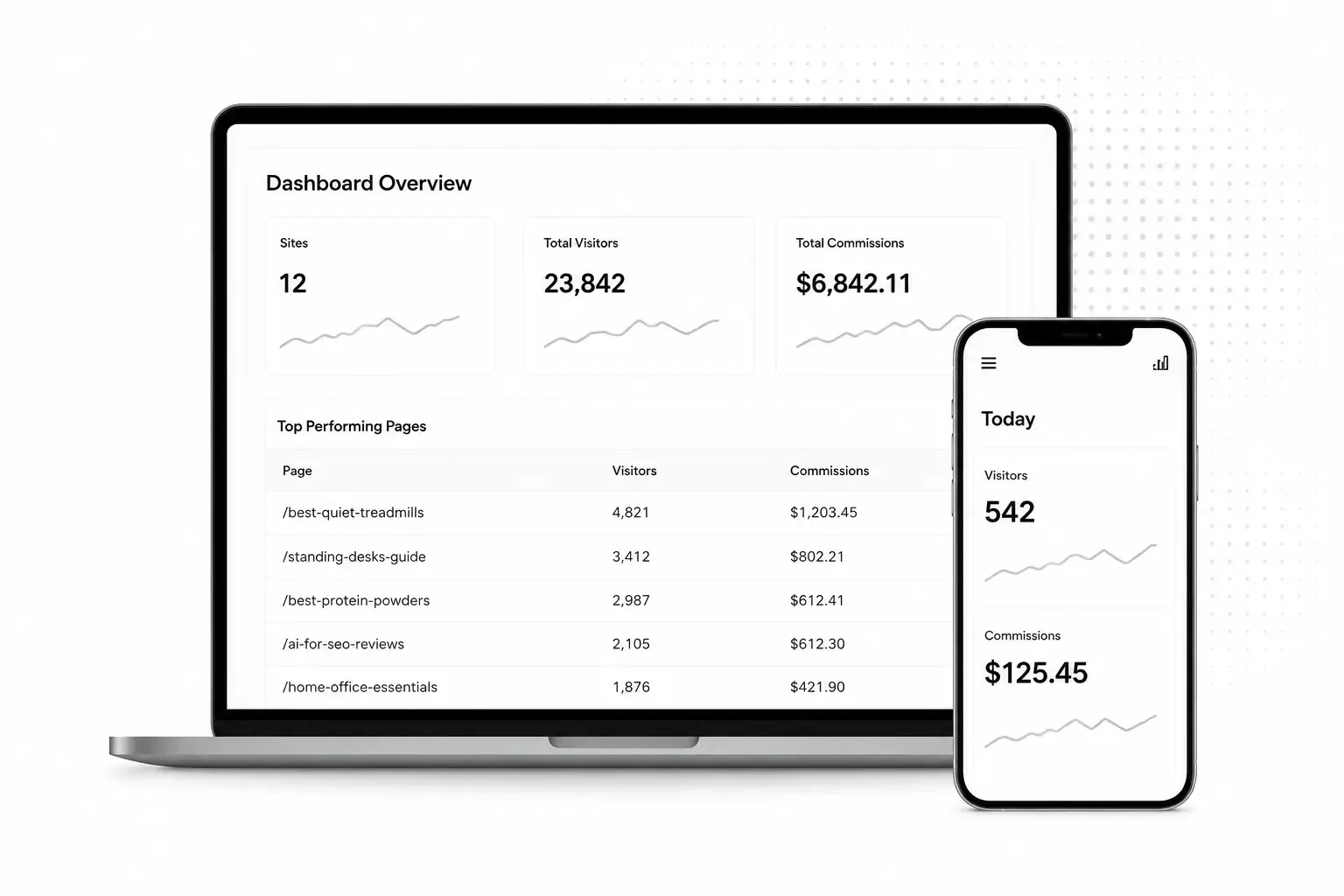
I have also started using AWeber to build email lists around my niche sites. Email subscribers are more likely to click affiliate links than random visitors. Plus, you can send them curated recommendations and product updates, which keeps the income steady even when search traffic dips.
Common Mistakes and How to Avoid Them
The easiest trap to fall into is publishing pure AI content without human oversight. I have seen sites that read like a robot wrote them. They use vague language, repeat the same sentence structures, and lack any real insight. Google SEO updates have gotten better at detecting this kind of content. It rarely ranks well, and when it does, it does not convert because readers bounce immediately.
Another mistake is ignoring technical SEO. You can have the best content in the world, but if your site loads slowly on mobile or has broken links, you will lose traffic. That is why I recommend Kinsta for hosting and RankMath for ongoing audits. Also, do not neglect image optimization. Midjourney images can be large. Resize them in Canva and compress them before uploading.
Some people think affiliate sites with AI are a set-and-forget system. They are not. You need to update old posts, check that affiliate links still work, and add new products as they come out. I spend about two hours a week maintaining my main site. That is not much, but it is not zero.
Realistic Income Expectations
I will be honest: most affiliate sites do not make money in the first six months. You are building authority and waiting for search engines to trust you. During that time, focus on producing at least 20 to 30 solid articles. Use Google Analytics to see which topics get clicks and double down on those. Once you start seeing regular traffic, apply for higher-paying programs on ShareASale or ClickBank.
After a year of consistent work, a single niche site can earn anywhere from a few hundred to a few thousand dollars per month. The sites that do best tend to focus on products with recurring commissions, like software subscriptions or membership programs. For example, promoting a tool like Builderall or AWeber pays better than selling a one-time gadget on Amazon Associates.

Final Thoughts on the Process
Building affiliate sites with AI is not magic. It is a workflow that combines the speed of modern language models with the judgment of a real marketer. If you treat the AI as a junior writer who needs clear instructions and editing, you will produce content that helps people and earns commissions. If you rely on it to think for you, the results will be mediocre.
I have seen friends succeed using Squarespace and Blogspot for simple niche sites, though I prefer WordPress with WooCommerce for flexibility. The platform matters less than the consistency of your effort. Pick one niche you know something about, research it deeply, and use AI to scale your writing without losing your voice. That is how you turn a side project into real passive income.
Corrections
Spot something wrong? Send it to the desk and it gets fixed in the open.